Layered Security in the Cannabis Industry
Layered Security in the Cannabis Industry: What 15 Years in the Field Has Taught Me
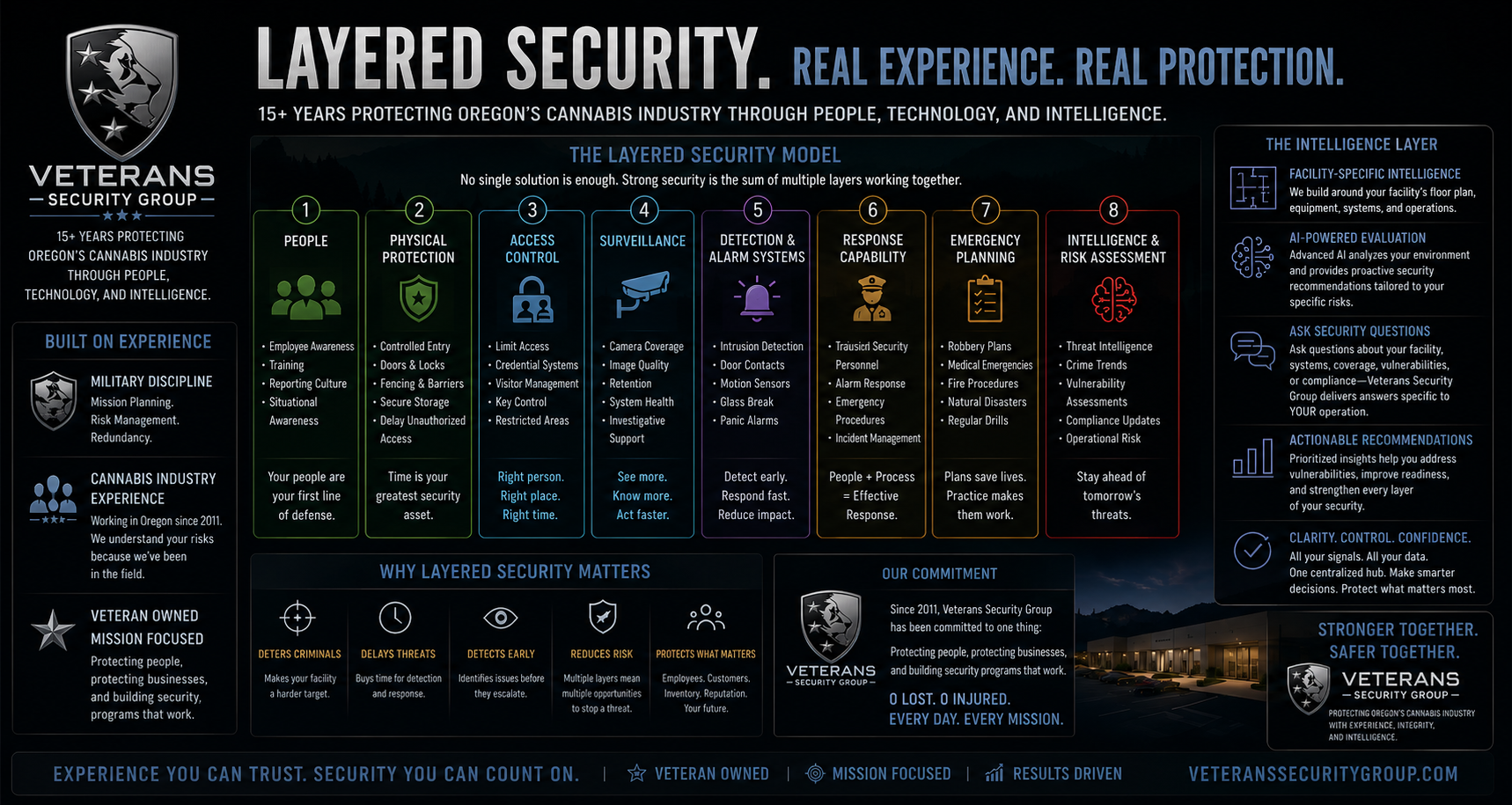
The Evolution of Cannabis Security: A Layered Approach
When I entered the Oregon cannabis industry in 2011, the landscape looked very different than it does today. Most operators were focused on getting licensed, building facilities, managing inventory, and navigating a constantly evolving regulatory environment. Security was often viewed as a requirement rather than a business function.
Over the last fifteen years, I’ve had the opportunity to work alongside cultivators, processors, distributors, retailers, executives, and investors throughout the cannabis industry. During that time, I’ve seen businesses thrive because they took security seriously, and I’ve seen organizations learn difficult lessons after discovering that compliance alone does not equal protection.
One lesson has remained constant: The strongest cannabis security programs are built on layers.
Not cameras. Not alarms. Not guards. Layers.
My Foundation: Learning to Think in Layers
Before entering the private security industry, I served in the United States Air Force as a firefighter and rescue technician assigned to RED HORSE operations. In military environments, survival often depends on redundancy.
- You don’t rely on a single piece of equipment.
- You don’t rely on a single communication method.
- You don’t rely on a single defensive position.
You build overlapping systems that continue functioning when one layer fails. That mindset followed me into the cannabis industry. The facilities that consistently perform well are rarely the ones with the most expensive technology; they’re the organizations that have created multiple layers of protection that work together.
If one layer fails, another remains. If one system misses something, another catches it. That philosophy has shaped how Veterans Security Group approaches security to this day.
Security Is Not a Camera System
One of the most common mistakes I see is treating security as a technology purchase.
- An operator installs cameras.
- An alarm company installs sensors.
- A few procedures get written.
- The facility passes inspection.
- Everyone feels secure.
Unfortunately, security doesn’t work that way. A camera records an incident; a security program prevents, detects, delays, and responds to incidents. Those are two very different things.
Over the years, I’ve reviewed countless facilities where every compliance box was checked, yet significant vulnerabilities still existed. The issue wasn’t the equipment—the issue was the lack of integration between the layers.
The Four Core Layers of Security
Layer One: People
The most important security asset in any organization is its people. Employees see things technology often misses:
- They notice unusual behavior.
- They recognize operational changes.
- They identify problems before those problems become incidents.
The best facilities invest heavily in training employees to recognize risks, report concerns, and understand emergency procedures. Security awareness creates force multiplication across an organization.
Layer Two: Physical Protection
Physical barriers buy time. This includes doors, locks, gates, fencing, restricted-access areas, and secure storage locations. The purpose of physical security is not necessarily to stop every threat; its purpose is to delay unauthorized access long enough for other layers to activate. Time is one of the most valuable assets in security.
Layer Three: Surveillance and Detection
Video surveillance remains a critical component of cannabis security. However, cameras are only valuable when they are properly designed, maintained, and reviewed. Surveillance should support both compliance and decision-making, providing visibility into what’s happening and how quickly leadership can respond.
Layer Four: Response Capability
Detection without response has limited value. Every organization should understand:
- Who responds to alarms?
- Who manages emergencies?
- Who makes decisions during critical incidents?
- How are employees protected?
- How are incidents documented?
Whether through internal teams, contract security, management personnel, or law enforcement coordination, response planning remains one of the most important layers in any security program.
The Layer Many Operators Are Missing: Intelligence
Over the last several years, I’ve noticed a new challenge: Information Overload. Operators are receiving more information than ever before:
- Security alerts and alarm notifications
- Compliance updates and regulatory changes
- Vendor notifications and camera health warnings
- Access control events and employee concerns
- Threat intelligence
Business owners are being flooded with signals from dozens of different systems. Most don’t have the time to sort through everything or know which signals matter most. This is where security begins evolving from traditional protection into intelligence-led protection.
Why We Built VSG Nexus
As Veterans Security Group continued working with cannabis operators throughout Oregon, we identified a growing need. Businesses didn’t need more dashboards; they needed clarity.
They needed a way to organize security information, compliance readiness, operational risks, and threat indicators into a single operational picture. That realization led to the development of VSG Nexus.
VSG Nexus is designed to function as a Digital Chief Security Officer for cannabis operators. Instead of forcing managers to jump between multiple systems, Nexus consolidates those signals into one centralized environment.
The goal is to transform information into actionable intelligence. Business owners should be able to quickly understand:
- What requires attention
- What is operating normally
- What compliance gaps exist
- What actions should be prioritized next
In many ways, Nexus represents the newest layer in the layered security model. It sits above the traditional security stack and helps organizations understand how all the other layers are performing.
The Future of Cannabis Security
The cannabis industry continues to mature, and threats continue to evolve. As the industry grows, I believe successful operators will move beyond compliance-focused security and toward intelligence-driven security.
The organizations that perform best won’t necessarily have the most cameras or the largest budgets. They’ll be the organizations that understand how to integrate people, processes, technology, response capabilities, and intelligence into a unified system.
That’s what layered security has always been about: not relying on a single solution, but building a resilient system where every layer strengthens the next. Security is strongest when no single layer carries the entire burden—because eventually, every layer will be tested. The question is whether the layers behind it are ready.