
C_THR70_2609 Scenario Questions: Practise Investigating Incentive Payout Issues
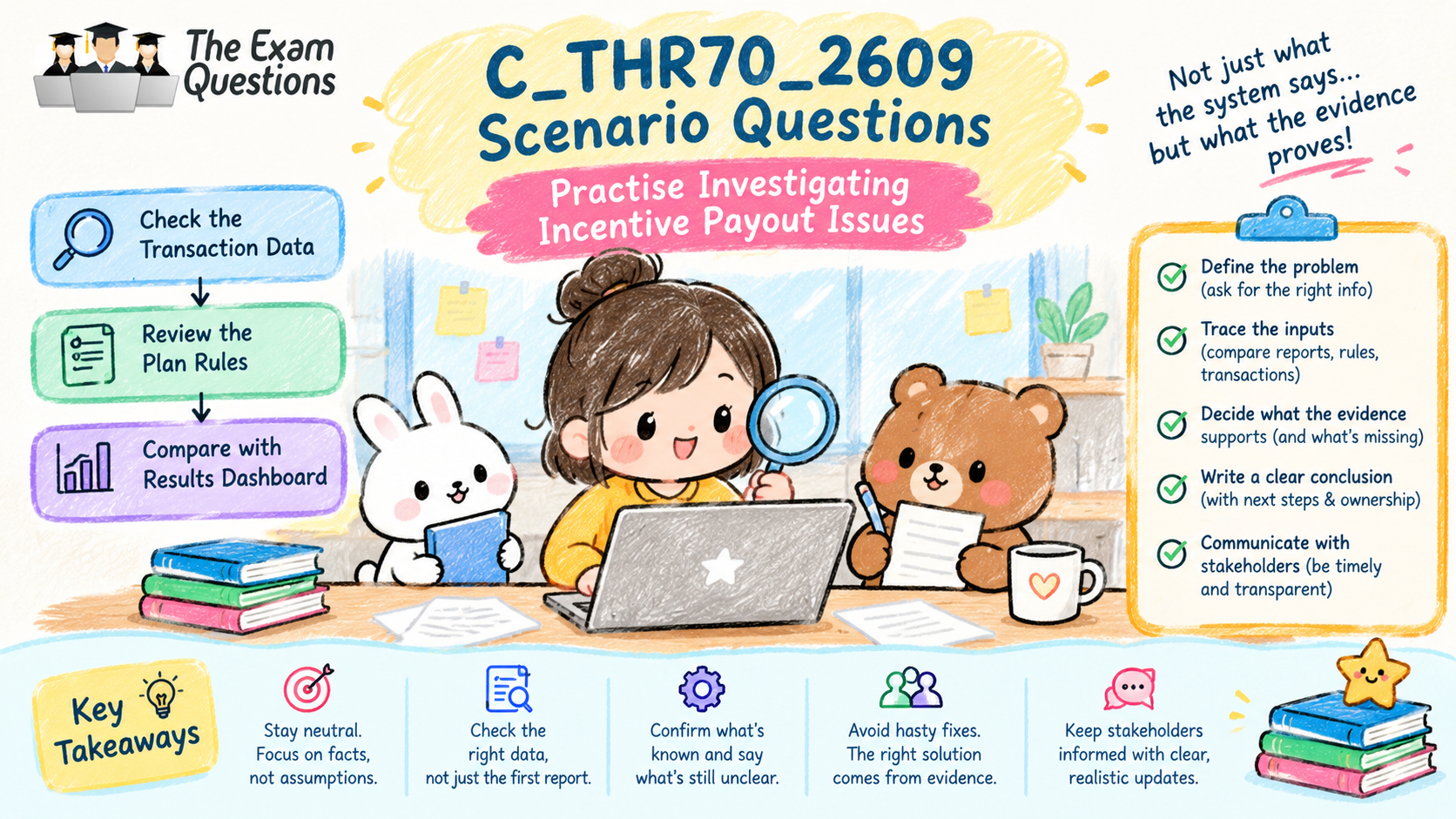
Memorising definitions only gets you so far. When a question describes a messy, realistic situation, you have to decide what to ask, what to check and what to say, and the order in which you do those things matters. These C_THR70_2609 Scenario Questions use a single illustrative incentive payout issue to help you practise that kind of reasoning from start to finish. The case is invented for learning. It is not an actual exam item, it does not describe how any particular SAP screen or calculation behaves, and it should be used alongside official SAP material rather than in place of it.
TL;DR
A payout that looks wrong is a symptom, not a diagnosis. Before you suggest any fix, confirm the case details, trace the relevant inputs, compare them with the rules that applied, and record what the evidence does and does not support. If the evidence is incomplete, say so and name the next step.
Why practise with a case study instead of isolated questions?
Isolated questions test whether you recognise a term. A case study tests whether you can behave sensibly when information is missing, reports disagree and someone wants an answer today. Those are the conditions in which scenario-based questions are usually built, and they are also the conditions in which people make avoidable mistakes.
Working through one case slowly has a second benefit. You can see how each decision depends on the one before it. If you skip the step where you define the problem, your later analysis may be careful but aimed at the wrong target. If you skip the step where you document what you found, you cannot explain your reasoning afterwards, and explaining your reasoning is exactly what builds lasting understanding.
Take your time with the prompts below. Write your answer first, in your own words, and only then read the guidance.
The case: a payout that looks too low
A sales manager contacts you. One representative on their team received a lower incentive payout than the manager expected. The manager sends a single screenshot of a results view and a short message saying, “This is clearly wrong, please fix it before payroll closes.”
The message does not include the reporting period, a list of transactions, the plan the representative was assigned to, or an explanation of how the expected figure was reached. You have not yet seen any underlying data. Your job is to work out how to investigate responsibly.
Notice what the manager has given you: a conclusion (“clearly wrong”), a deadline (“before payroll closes”) and a request (“fix it”). What the manager has not given you is evidence. A good investigator separates those things early.
Part 1: Define the problem before you touch the data
Question 1: What information would you request before comparing the expected and actual payout?
Write down everything you would need before you could say whether the payout is wrong.
What a strong answer includes: The relevant period and the participant concerned. The plan or rules that were meant to apply to that participant in that period. The transactions or credits the manager believes should have counted. Any target, quota or threshold information that the expected figure depends on. Most importantly, the source of the expected figure. Was it a spreadsheet, a previous payout, a verbal estimate or a different report? An expected number with no source is only an opinion until you can reproduce it.
You are not being difficult by asking for this. You are establishing that both sides are talking about the same thing.
Question 2: How would you restate the problem in one or two sentences?
Before investigating, practise summarising the issue neutrally. For example: “The manager reports that the payout for a named participant in a stated period is lower than expected. The expected amount and its source are not yet confirmed.”
What a strong answer includes: A statement that separates the reported symptom from any assumed cause. Notice that this restatement does not say the calculation is wrong, the data is missing or the plan was misconfigured. It says only what is known. A neutral problem statement protects you from anchoring on the first explanation that comes to mind.
Part 2: Trace the inputs
Suppose the manager replies with a period, a participant name and a spreadsheet showing what they expected. You now begin comparing figures. Then a complication appears.
Question 3: The transaction total appears different between two reports. What would you verify before drawing a conclusion?
Two reports, both apparently about the same representative, show different transaction totals.
What a strong answer includes: A check that both reports cover the same date range and the same participant. A check of any filters applied to each report. Whether the data in each was refreshed at the same point in time. Whether both include the same transaction statuses. Whether the reports define their totals in the same way. Record each difference you find instead of deciding in advance that one report is right. Two reports can disagree because their scope differs, not because either one is faulty.
If you cannot confirm how a report was produced, treat its figures as unverified and ask the person who ran it.
Question 4: Which inputs would you review once the reports are reconciled?
Assume you now agree on the transaction total. The payout may still differ from the expectation.
What a strong answer includes: The transactions or credits that fed the result and whether any are missing, duplicated or classed differently than expected. The rules or plan components that applied to the participant and period, compared with the manager’s assumptions about them. Any performance information the result depends on. Keep your language careful here. You are comparing what the evidence shows with what the rules say should happen, and you should rely on documented plan details and official SAP information rather than guesses about how the product behaves.
Part 3: Decide what the evidence supports
Now the case becomes harder. You have reviewed some inputs, but the data still looks incomplete. The manager sends another message: “Payroll closes tomorrow. Can you just adjust the payout?”
Question 5: The data looks incomplete. Should you recommend a payout correction immediately? Why or why not?
What a strong answer includes: A defensible response is to avoid recommending a final correction until the cause and its impact are validated. Acknowledge the deadline, because pressure is real and ignoring it would be unhelpful. Then explain what is missing, who can confirm it and when you will provide an update. You might also identify who has the authority to approve any adjustment, because investigating and approving are not always the same role.
A hasty correction can create a second problem on top of the first. If the original result was right, an unnecessary adjustment introduces an error. If the original result was wrong for a different reason than you assumed, the adjustment may not fix it.
Question 6: What if the investigation is inconclusive?
Suppose you have checked everything you can access and a gap remains.
What a strong answer includes: A clear statement that the cause has not been confirmed, a list of what has been ruled out, and a precise description of what is still needed. This is not a failure. An honest “we do not yet know, and here is how we will find out” is more useful than an invented explanation, and it is the response that keeps trust intact.
Part 4: Write the case conclusion
A good investigation ends with a short written conclusion that someone else could read without needing you in the room. Use this outline and fill in each element from the case:
1. Issue reported: what the manager said, stated neutrally.
2. Evidence reviewed: the reports, records and plan details you examined.
3. Checks completed: the comparisons you performed, such as period, filters and transaction status.
4. Findings confirmed: only what the evidence directly supports.
5. Open questions: what remains unknown.
6. Recommended next action: the single most useful next step and who owns it.
7. Stakeholder update: what you will tell the manager and when.
If the evidence is inconclusive, state that clearly rather than inventing a cause. Reading your own conclusion back is a useful test. If a colleague could not tell which statements are confirmed and which are assumptions, rewrite it.
How should you talk to the stakeholder while the investigation is open?
Many learners prepare well for the analytical side and neglect communication. In a scenario question, the best answer usually does both.
Start with what you understand about the concern. Say what you are checking and why. Be plain about what you cannot yet say. Give a realistic time for the next update, and keep to it. Avoid technical detail that does not help the manager decide anything, but offer it if they ask.
For example, instead of “the issue is under investigation,” try: “I have confirmed the period and participant and I am comparing the transactions in both reports. I will update you by end of day with what I have confirmed and what I still need.” The second version shows progress, sets expectations and does not overpromise.
Use the official SAP reference to keep your revision accurate
Practice cases help you rehearse reasoning, but they cannot tell you what the certification covers. For that, use the official SAP certification page. Check the current certification name, the listed topic areas and any preparation guidance, then compare them with your own notes. Where you cannot explain a listed topic confidently, revisit it before moving on.
Treat any third-party material, including this article, as supplementary. Certification details can change, and SAP’s own information is the authority.
Video resource
If you would like a different angle on the topic, this supplementary video can accompany the exercise:
After watching, pause and write down how you would apply one idea from it to the payout case above. Be specific. Which question in this article would it have changed your answer to, and how?
Frequently asked questions
Does a payout difference always mean there is an error?
No. Differences can come from mismatched periods, filters, definitions or expectations. Confirm that you are comparing like with like before concluding anything.
Are these practice prompts real exam questions?
No. They are original study exercises written to practise reasoning. They do not represent actual or confidential exam content, and they do not predict what will appear on the exam.
What is the most useful habit to take from this case?
Separate what you have confirmed from what you are assuming, and say which is which every time you report.
For more learning and practice material, visit The Exam Questions and continue building your ability to explain each step with evidence.